
From selecting the right inputs to improving efficiency, growers are looking for agronomic solutions and guidance tailored to their operations
- Organic growers see opportunities to improve efficiency and adopt practical innovations that address real production challenges.
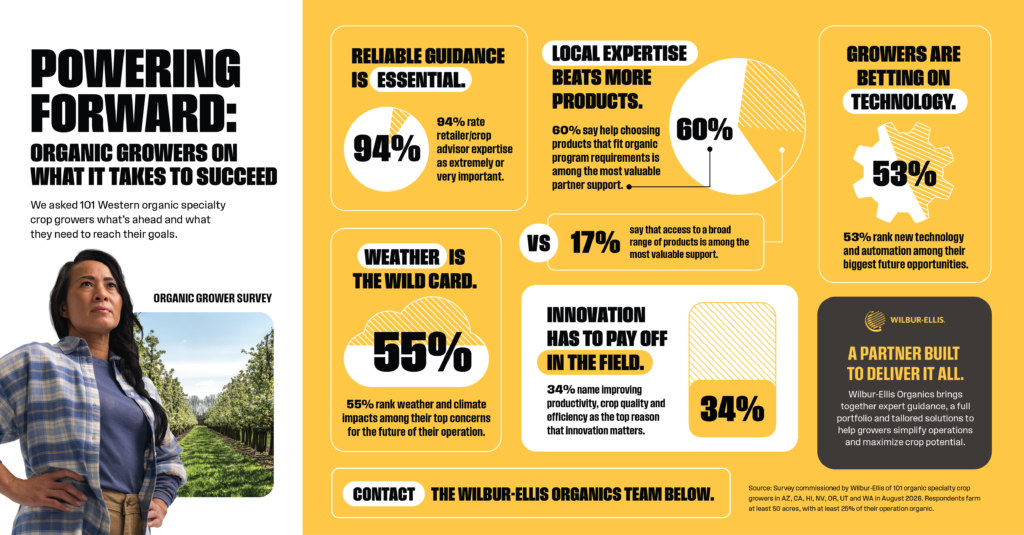
- 60% of surveyed organic growers prioritize help identifying products that fit organic program requirements, reinforcing the value of a crop advisor who understands their unique production needs.
- With weather, rising input costs and product availability creating uncertainty, a local crop advisor can help growers adapt and make more confident decisions.
Organic growers are looking ahead with a focus on improving efficiency, adopting practical innovations and navigating the challenges of an increasingly complex production environment. A recent Wilbur-Ellis survey offers insight into the opportunities organic growers see for the future, and the expertise and agronomy services they value along the way.
The survey of 101 organic specialty crop growers in the Western U.S., 84% of whom also farm conventional acreage, found that new technology and automation topped the list of opportunities for the future of organic operations (53%), followed by improving operational efficiency (44%) and innovation in crop inputs (39%).
Growers also identified significant challenges. Weather and climate impacts were among the top three concerns for 55% of respondents, followed by rising input costs (37%) and access to approved organic inputs (35%).
“Organic growers are managing incredibly sophisticated operations, and they’re constantly balancing production challenges with the need to remain profitable,” says Gina Colfer, sustainable solutions agronomy manager for Wilbur-Ellis. “What stands out in this research is that growers are looking ahead. They see opportunities to improve efficiency and adopt new agronomic solutions, but they also recognize the importance of having the right support to fully realize those opportunities.”
Organic growers seek support in a complex production environment
From changing weather conditions to input costs, organic growers face challenges they can’t always control. But the survey suggests that having the right agronomic support can help growers adapt to uncertainty and make more confident production decisions.
When asked which types of support they value most from an organic agronomist or input partner, respondents prioritized:
- 60% — Help identifying products that fit organic program requirements
- 48% — Support coordinating products across multiple input categories
- 46% — Consistent availability of approved organic inputs
- 41% — A single trusted point of contact who understands their operation
- 35% — Local agronomic expertise and crop-specific recommendations
By comparison, just 17% selected access to a broad spectrum of organic products among their top three priorities, highlighting that growers value local expertise over access to a broad portfolio. In fact, 94% of respondents said retailer or crop advisor expertise is extremely or very important to their operation’s success.
“Growers know their operations best, but organic production requires a lot of moving pieces to work together,” says Colfer. “Our role is to bring the local agronomic knowledge to help them navigate those decisions and build programs that work for their crops and goals.”
Wilbur-Ellis supports this approach by combining agronomic solutions and expertise at the local level with broader technical resources and access to organic crop nutrition, crop protection and other inputs. Local teams understand the crops, growing conditions and production challenges specific to their regions, while the company’s broader resources contribute to their large supplier network and help them evaluate agronomy services across multiple input categories.
This combination allows Wilbur-Ellis to work alongside growers throughout the season, developing recommendations based on their crops, production goals and organic program requirements, then adjusting those recommendations as conditions change.
Practical innovation is a priority for the future
When asked why innovation matters to the future of their operations, respondents most frequently cited improving productivity, crop quality and efficiency (34%), managing pest, weed and disease pressures (28%) and protecting soil health (28%).
Grower priorities for innovation span multiple crop-input categories. Herbicides (51%) and micronutrients (50%) led the list of areas where organic growers want advancements, followed by potassium (42%) and nitrogen (36%). While these findings reflect growers’ organic production priorities, the need for practical solutions extends to growers incorporating organic inputs into conventional, regenerative and other sustainability-focused production systems.
For Wilbur-Ellis, the findings reinforce the importance of developing agronomic solutions that address real production challenges. One example is BenVireo® TerraLux™, an OMRI-listed organic ammonium nitrate liquid fertilizer that contains 100% plant-available nitrogen, low salt and a neutral pH. In a third-party field trial on organic spinach in Arizona, a BenVireo TerraLux-based fertility program reduced nitrogen use by 57% while increasing return on investment by $3,000 per acre compared with the programs evaluated. The trial also demonstrated improvements in crop uniformity and development.¹
“Growers aren’t interested in innovation just for the sake of having something new,” says Colfer. “They want solutions that solve problems they’re dealing with every day and help them get more out of their operations. That’s where we believe innovation can make the greatest difference.”
Wilbur-Ellis continues to invest in organic crop nutrition, crop protection and other technologies that help growers address production challenges while meeting organic program requirements.
Crop advisor insights help organic growers prepare for what’s next
The survey findings reflect an organic industry focused on improving efficiency and finding practical ways to strengthen production in the face of uncertainty. They also reinforce the value of collaboration between growers and knowledgeable agronomic partners.
“Organic growers are always looking ahead, and so are we,” says Colfer. “Our goal is to understand where their biggest challenges and opportunities are, then bring together the expertise, products and support that help them move forward with confidence. That’s what being a trusted partner means to us.”
Contact your local Wilbur-Ellis representative to discuss your organic production goals and explore agronomic solutions tailored to your operation.
Survey Methodology
The survey was conducted in August 2026 among 101 organic specialty crop growers in Arizona, California, Hawaii, Nevada, Oregon, Utah and Washington. 16% of respondents farm exclusively organic acreage, 80% farm a mix of organic and conventional that is at least 50% organic, and 4% farm 25% organic/75% conventional. 77% farm between 100 and 499 acres of organic specialty crops. Respondents represented a diverse range of crops, led by tree fruits, leafy vegetables and berries.
References
1 – Wilbur-Ellis trial data 5PN26LFYAZ1 = 313PN25LFYAZ1and 6PN26LFYAZ1