


A new playbook for organic nitrogen management
Targeted nitrogen strategies and timely applications help boost crop performance while reducing inputs
- Nitrogen availability remains one of the biggest challenges limiting yield, quality and profitability in organic production.
- Matching nitrogen applications to crop demand can improve nutrient-use efficiency and reduce reliance on large upfront fertilizer applications.
- Healthy, biologically active soils help support nutrient cycling; strategic in-season nutrition is often needed during critical growth stages.
- New technologies such as BenVireo® TerraLux™ are helping growers improve crop uniformity, increase ROI and maintain productivity with lower nitrogen rates.
For nearly all growers, nitrogen (N) is the biggest driver of consistent yields, crop quality and profitability. But for organic growers, it’s an even more significant factor, since finding a source of readily available N can be a challenge.
Unlike conventional systems, where N can be applied from a variety of sources, organic production has fewer options and is often at the mercy of volatilization from preplant dry N applications. As a result, ensuring organic crops have access to the right N at the right time requires careful planning and management.
Today, many organic growers are rethinking their approach to fertility. Rather than simply increasing N applications in hopes that it will remain available when the crop needs it, the focus is shifting toward improving N availability and nutrient use efficiency throughout the growing season.
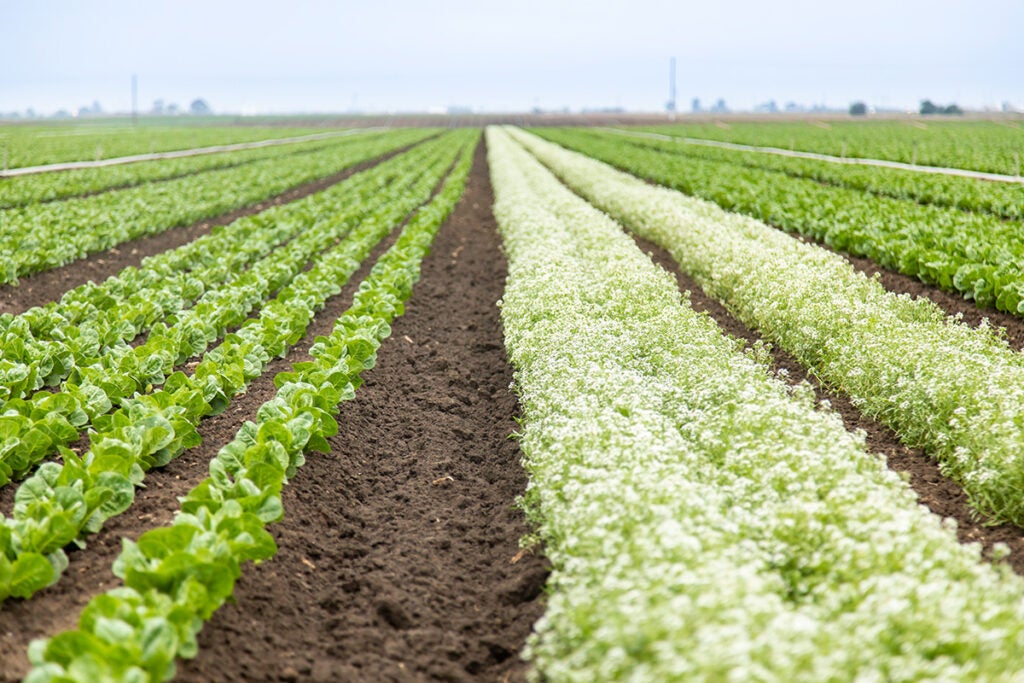
It starts with healthy soil
According to Gina Colfer, Sustainable Solutions Agronomy Manager for Organics at Wilbur-Ellis, effective N management begins with a healthy, functioning soil system.
“Good soil health is the foundation of a successful, balanced nutrition program and preventative pest management program,” Colfer says. “Because it all starts in the soil, and how healthy your soil is to support a resilient crop. You want your soil to be resilient so your crop can be resilient.”
Healthy soils support the biological activity responsible for breaking down organic matter and releasing nutrients, like N, in plant-available form. However, one of the greatest challenges in organic production is predicting exactly when that N will become available.
Historically, many growers have relied on large pre-plant N applications because of this uncertainty. “Organic growers may not know when N will become available for the crop, so they apply it all up front and hope,” Colfer says.
While that approach can help ensure nutrients are present, it can also lead to inefficiencies, increased nutrient losses and higher input costs. These factors are always of significant concern to growers, but particularly today with rising fertilizer and other input costs.
Align N use with demand
A more effective strategy is to align nitrogen availability with crop demand throughout the season. By supplying nutrients during key growth stages rather than relying solely on upfront applications, growers can improve nitrogen-use efficiency while supporting more consistent crop development.
“It’s more prescriptive; you’re feeding the crop when it needs it,” says Colfer.
This approach becomes especially important during periods of rapid growth, reproductive development and environmental stress. Heat, irrigation challenges and low-organic-matter soils can all limit nutrient uptake, making the timing of N availability even more critical.
“Having that functioning soil system as a foundation is the basis for success,” adds Colfer.

Equip your crop nutrient toolbox
As growers look for ways to improve efficiency, products that deliver readily available N are gaining attention. One option is BenVireo® TerraLux™, which supplements biological nutrient cycling and provides crops with N during critical growth periods.
Colfer points to recent third-party field research on organic spinach in Arizona as an example of how targeted N management can influence crop performance. In the trial, researchers compared standard fertility programs with reduced N rates to a BenVireo TerraLux-based program.
“We reduced N by 57% with BenVireo TerraLux, and increased ROI by $3,000 per acre,[1]” Colfer says. “Additionally, the crop stand establishment was more uniform and the plants grew more evenly and bigger.”
[1] Wilbur-Ellis trial data 5PN26LFYAZ1 = 313PN25LFYAZ1and 6PN26LFYAZ1
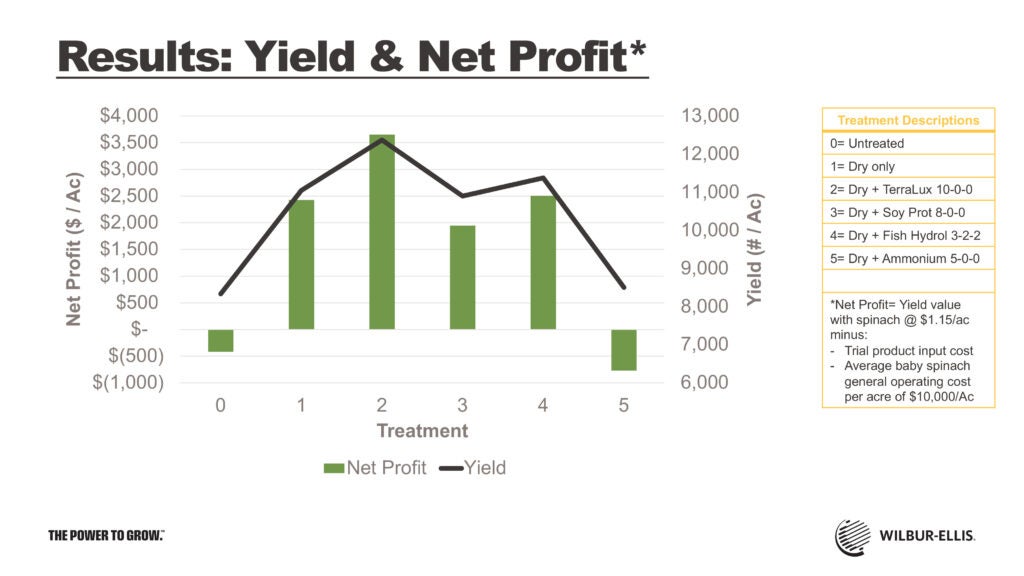
stand uniformity and overall production. (Trial 5PN26LFYAZ1 = 313PN25LFYAZ1and 6PN26LFYAZ1)
Uniformity is often an overlooked contributor to profitability, particularly in high-value specialty crops. Consistent stand establishment and crop development can improve marketability while reducing variability across the field.
“When you build the structure of the plant during that vegetative growth, it’s able to sustain the fruit-loading component of that crop,” Colfer says. “Even with permanent crops, you’re able to grow that tree or vine strong from the start so then it can hold on to the fruit and grow it big.”
The benefits extend beyond yield potential. Crops that receive adequate nutrition during periods of stress are often better positioned to maintain growth, quality and overall vigor throughout the season.
Increase nutrient use efficiency
Growers are also facing increasing pressure to improve nutrient use efficiency. Water quality initiatives and evolving nutrient management requirements are encouraging growers to find ways to maintain productivity while minimizing N losses.
“We’ve got to figure out how to produce crops with less N,” Colfer says. “We need product substitutions, biostimulants and nutrient-use-efficient fertilizers.”
Ultimately, Colfer believes products such as BenVireo TerraLux should be viewed as part of a broader fertility strategy. “It’s a tool in the toolbox,” she says.
For organic growers seeking to maximize performance, success increasingly depends on delivering nitrogen more efficiently and making nutrients available when crops need them most. Combined with sound soil management practices, strategic nutrient timing and new fertility technologies, this approach can help improve profitability, crop consistency and long-term resilience.
Your local Wilbur-Ellis agronomist can help you create a nitrogen strategy that aligns with your goals, supports crop performance and adapts to changing conditions. To learn more, visit itsorganic.com.