
- Post-harvest nutrition helps replenish nutrient reserves needed for spring growth.
- El Niño could bring wetter winter conditions that limit orchard access and fertility timing.
- Tissue, hull, and soil tests should guide fall nutrient decisions.
- Addressing verified deficiencies this fall can help prepare trees for spring and provide flexibility if winter weather limits applications.
Targeted fall nutrition plans can help nut growers prepare for spring.
Harvest may be wrapping up, but the work your trees are doing isn’t over.
After harvest, trees begin to rebuild and store nutrient reserves that can help support bud development, bloom, fruit set, and early growth in the spring. Leaves can remain active well into the fall, making the post-harvest period an important opportunity to address verified nutritional needs before dormancy.
This year, that window may be especially important. A strong El Niño is expected this winter, increasing the potential for wetter conditions for nut growers in California and beyond. This doesn’t guarantee a wet winter, but saturated soils and repeated storms could make it harder to get equipment into orchards or make timely fertility applications ahead of spring growth.
Why is post-harvest nutrition important?
Following harvest, trees continue moving nutrients into storage tissues before dormancy. Those reserves help fuel growth the following spring, often before root activity and soil conditions can fully meet crop demand.
Addressing nutrient deficiencies during the fall can also provide more flexibility if wet winter conditions limit application opportunities at the beginning of the next season.
How should growers approach fall fertility?
The best post-harvest nutrition plan starts with data, not assumptions. Tissue, hull, and soil tests can help identify nutrient deficiencies, replacement needs following crop removal, and opportunities to improve nutrient management ahead of the next growing season. Because every orchard is different, growers should avoid a one-size-fits-all approach and instead make decisions based on crop, yield, orchard history, and current conditions.
For almonds, growers often evaluate nutrients such as zinc, boron, potassium, and nitrogen as part of their post-harvest planning process. Nutrient needs and timing may differ in pistachios, walnuts, and other permanent crops.
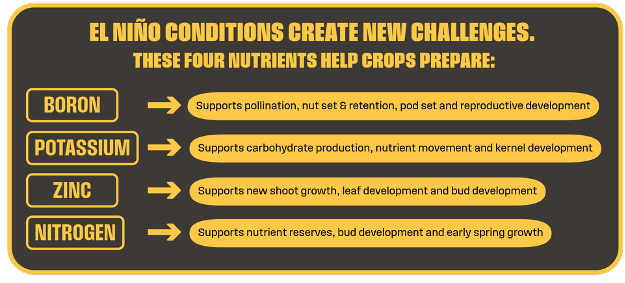
Depending on test results, growers may consider products such as FOLI-GRO® BORON 10% to address boron needs, MAX SET® NURISH® as part of a foliar nutrition program, TILL-IT® N-POWER™ when supplemental nitrogen is appropriate, or PURIC® WSG alongside post-harvest potassium applications. Product selection, rate, and timing should be based on tissue, hull, and soil test results, crop needs, and label directions.
Bo Christy, a Wilbur-Ellis territory manager, reinforced the importance of planning ahead: “In an El Niño year, post-harvest nutrition is more critical than ever. You’ve got to think ahead, as next spring’s success starts this fall. Building nutrient reserves now will help prepare the trees for periods when wet weather keeps you out of the orchard.”
Preparing for an uncertain winter
No one knows exactly what El Niño will bring to an individual orchard, but growers can use the outlook as one more reason to plan ahead. A targeted post-harvest nutrition strategy can help position trees for a strong start when spring arrives.
Talk with your local Wilbur-Ellis agronomist about your crop, test results, and orchard conditions to determine where a targeted fall fertility program may fit. Always read and follow label directions. Not all products are registered in all states.