

Early Season Almond Fertilization Strategies
S. Kaan Kurtural, PhD Senior Agronomy Information Technology Manager
- Applying almond tree fertilizer is important and time sensitive to make sure your crop is getting the most of its soil nutrition uptake.
- Using foliar fertilizer can help protect your almond from unpredictable weather changes during crucial parts in the growing season.
- Adding in a foliar fertilizer to your almond tree fertilizer plan can provide a greater nut meat yield.
As the new year starts, we are getting ready to break dormancy in almond orchards to commence the 2025 growing season. Prior to flush of root growth, immediately following bloom, leaf out begins in almond orchards. It is important to remember to correctly apply almond fertilizers.
When to Apply Almond Tree Fertilizer
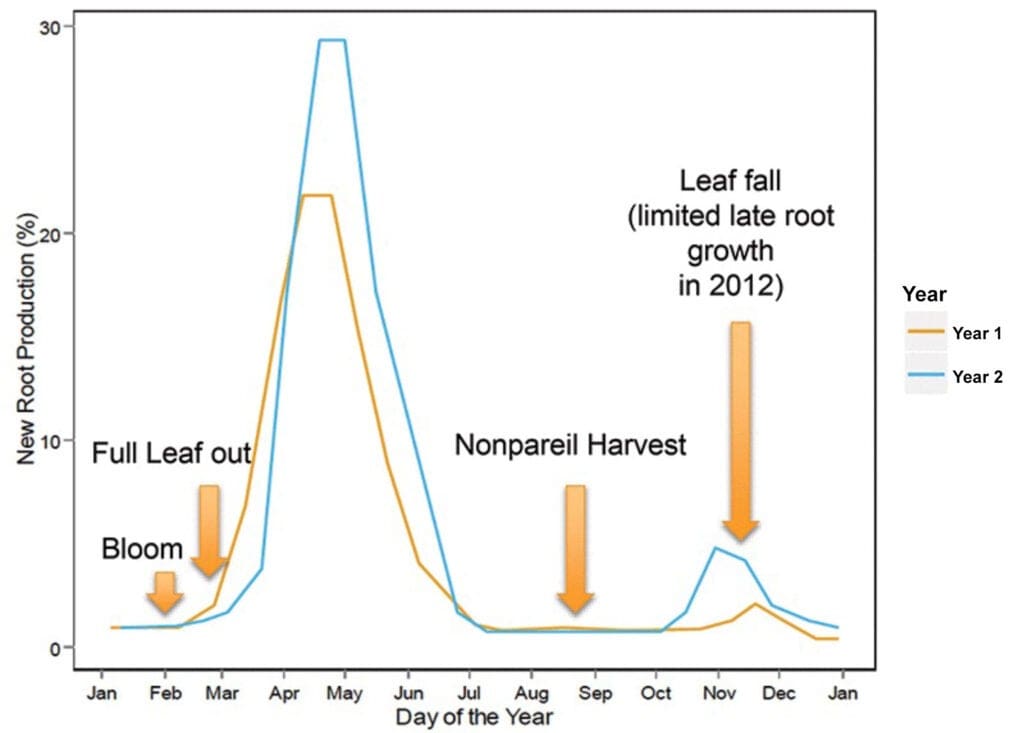
Growers need to be cognizant of the fact that nitrogen fertilizers applied prior to bloom have NO effect on bloom, early leaf growth, and shoot expansion. Remobilization of nitrogenous compounds is entirely driven by nutrients stored over winter from last year’s fertility program. Soil nutrient uptake will not occur until trees are active and leaves are transpiring. Without a transpiration stream pulling in soil moisture and the soluble nutrients contained in the root zone, there is no nutrient uptake. As depicted in Figure 1 below, there must be enough leaf expansive growth for root growth to happen.
Supporting Almond Nutrient Needs Early in the Season
The needs of the almond trees, especially for nitrogen, cannot be met by foliar applications alone. However, to ensure sustained leaf expansion (source of photosynthates) and mitigate untoward weather conditions such as early season heat waves, such as the ones we have witnessed during the 2024 season.


In independent studies conducted in California, foliar fertilizer applications of FOLI-GRO® POLISH®, or FOLI-GRO TIDALWAVE® or FOLI-GRO CA-ZN results indicated an average nut meat yield increase of 125 lbs/A to 364 lbs/A. FOLI-GRO POLISH, in addition to Calcium (Ca) and Zinc (Zn) needed to drive leaf expansion early in the season utilizes 5% nitrate nitrate-nitrogen that can be delivered at 20% bloom, full bloom, and petal fall (Figure 2). Likewise, adding a biostimulant to a grower standard program such as FOLI-GRO TIDALWAVE may also result in increased yields, ameliorating the plant-water-atmosphere continuum.
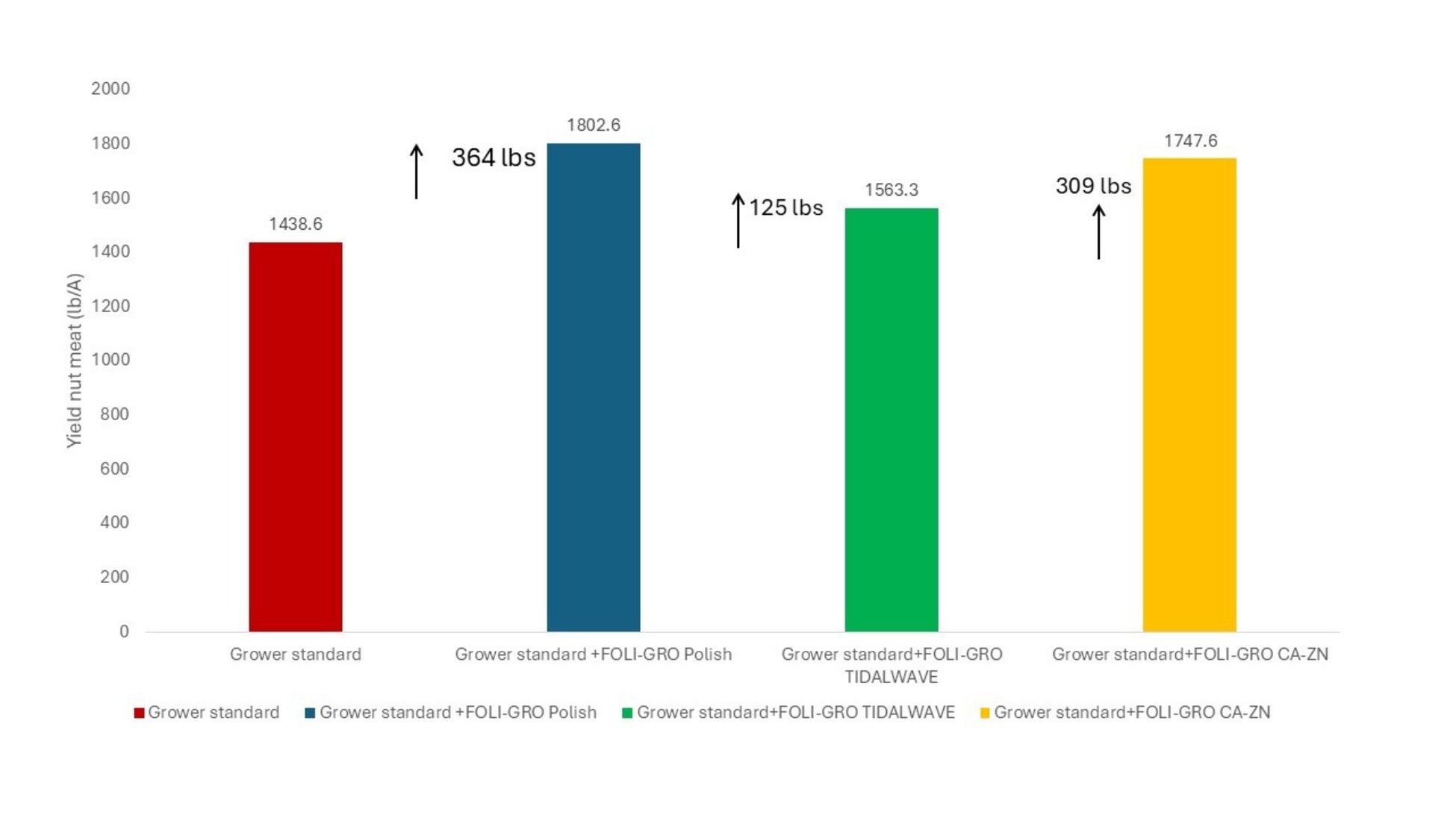
Although adding the FOLI-GRO CA-ZN provided a greater nut meat yield compared to grower standard, FOLI-GRO POLISH pushed yields even higher. These are good solutions that can ensure a more resilient orchard with higher yields.